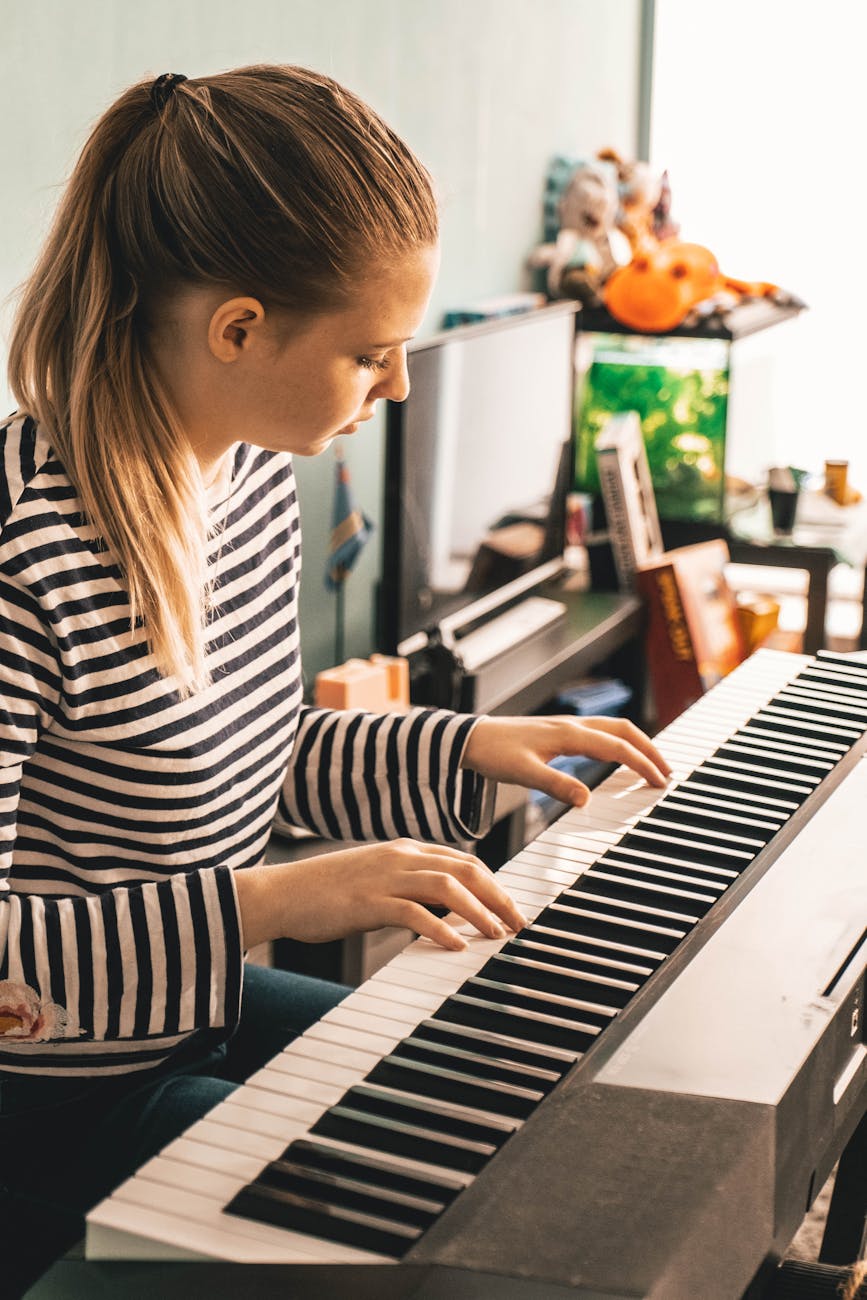
When you watch a skilled musician perform, what you don’t see is the journey that got them there: the focused practice, the slow breakthroughs, the hours of repetition, and the moment they finally mastered a once-impossible phrase. Learning a musical instrument isn’t just about making beautiful sounds—it’s about developing discipline, attention to detail, and the confidence to overcome obstacles.
These are life skills that extend far beyond music, and they begin to take shape from the very first scale.
🔁 Why Musical Practice Builds Grit
Angela Duckworth, author of Grit: The Power of Passion and Perseverance, defines grit as the ability to persist in the face of difficulty. Music offers a structured, rewarding environment to cultivate this trait.
“Effort counts twice: once when you learn something, and again when you apply it.”
— Angela Duckworth
Practising an instrument involves constant problem-solving:
- Breaking down difficult passages
- Pushing through frustration
- Refining technique over time
- Tracking progress week by week
Students quickly learn that progress is incremental, and that excellence is built on thousands of small improvements.
🧠 Focus and Executive Function
Playing an instrument also develops executive function, the brain’s set of tools for:
- Attention control
- Planning and goal-setting
- Working memory
- Self-monitoring
In a 2014 study by Dr. Nadine Gaab at Harvard, children who had two or more years of musical training outperformed non-musicians on tasks of executive function—even after controlling for IQ and socioeconomic background.
“Music training may improve the brain’s ability to focus, block out distractions, and retain instructions.”
— Dr. Nadine Gaab, Boston Children’s Hospital / Harvard Medical School
🗣️ Confidence Through Achievement
One of the most transformative effects of learning an instrument is the boost in self-confidence that comes from:
- Performing for others
- Achieving goals (e.g. passing a grade, learning a song)
- Expressing yourself without words
Real Voices
- Sheku Kanneh-Mason, cellist and BBC Young Musician winner:
“I had to practise performing in front of my family—hundreds of times—before I could walk on a stage. But each time I did, I grew more confident not just as a cellist, but as a person.”
- A student interviewed in a 2020 ABRSM Making Music report said:
“When I passed my Grade 2 violin, I felt like I could do anything—even if it scared me.”
Learning an instrument offers safe, structured experiences of challenge and success—vital for building resilience and self-worth.
📋 Practice Routines: A Case Study
Here’s a breakdown of a sample routine that builds focus and stamina in just 20 minutes a day:
| Time | Activity | Skill Targeted |
|---|---|---|
| 5 min | Warm-up scales/arpeggios | Coordination, tone, attention |
| 8 min | Practice one tricky section | Problem-solving, focus |
| 5 min | Review familiar piece | Memory, fluency |
| 2 min | Free play/improvisation | Creativity, reward |
Even this short routine helps form healthy practice habits, which students can carry into academics, sport, and daily life.
🎯 Try It Yourself: A Practice Journal
Encourage students or yourself to keep a practice journal, noting:
- Today’s goal (e.g. “Fix LH rhythm in bar 4”)
- What worked / what didn’t
- One thing to improve tomorrow
This habit encourages metacognition—thinking about how we think and learn. It transforms practice from repetition into reflection.
🎬 Watch this!
🧾 Sources & Further Reading
- Duckworth, A. (2016). Grit: The Power of Passion and Perseverance. Scribner.
- Gaab, N. et al. (2014). Musical Training and Executive Function. PLoS ONE.
- ABRSM (2020). Making Music: Teaching, Learning and Playing in the UK.
- Kanneh-Mason Foundation. (2023). Music Education and Access.
🎵 Final Thoughts
The discipline that grows from learning an instrument is not about rigidity—it’s about freedom through structure. As players gain mastery, they not only grow as musicians but as focused, resilient individuals ready to take on life’s many stages.
Up Next:
Post 4 – Music and Community: How Playing an Instrument Creates Social Bonds
 RobboDoesMusic
Leave a comment