
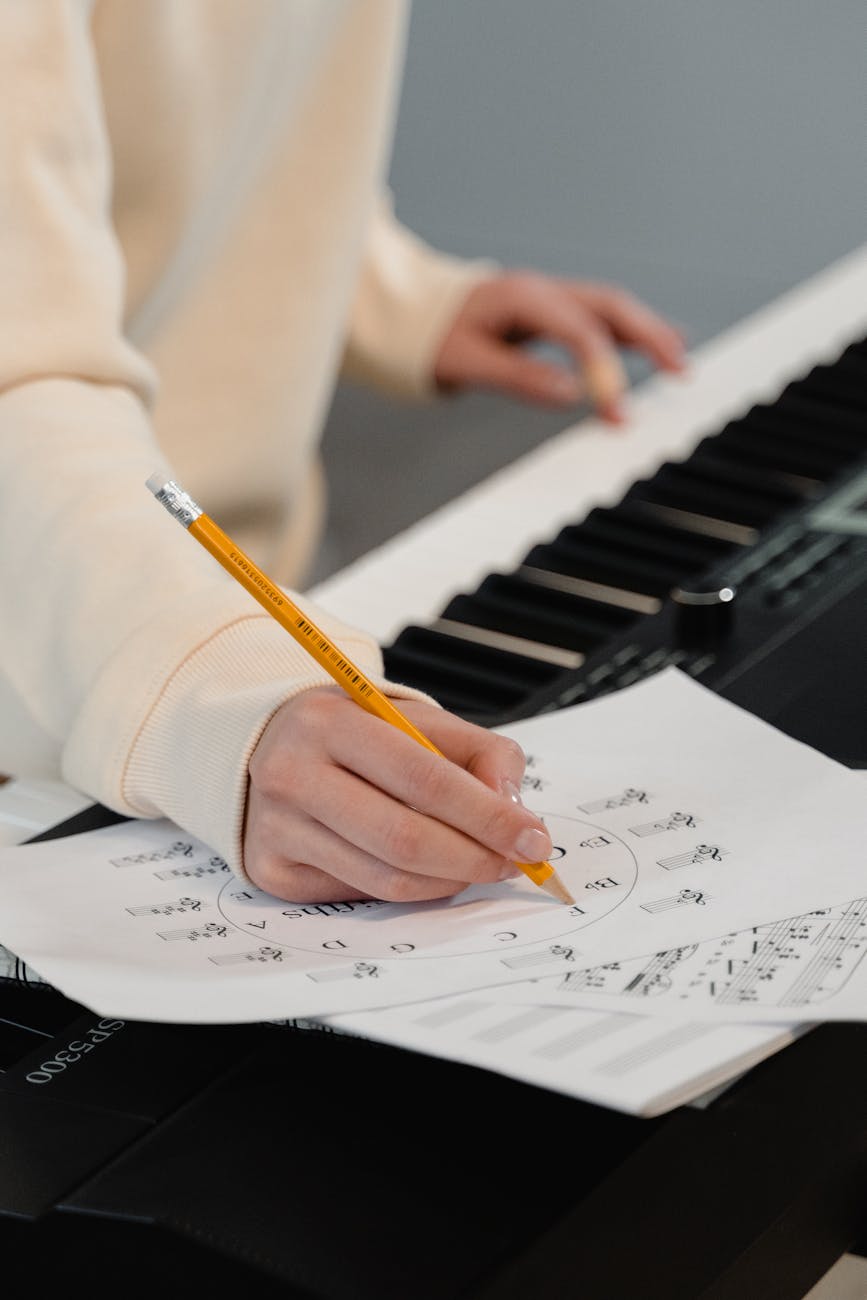
Grade 5 Music Theory is a major milestone for musicians — not only is it essential for progressing to Grades 6–8 in practical exams, but it also deepens your understanding of how music works. This guide breaks down the exam into manageable parts, offers revision tips, and helps you succeed with clarity and confidence.
📘 What’s in the Grade 5 Exam?
The ABRSM Grade 5 Music Theory exam is out of 75 marks. You need 50 to pass, 60 for Merit, and 66 for Distinction. The exam has six main sections:
1. Key Signatures and Scales
- Write major and minor scales (up to six sharps/flats)
- Understand harmonic and melodic minor forms
- Recognise and use key signatures correctly
📌 Tip: Practise writing all scales with correct accidentals and note spacing. Learn circle of fifths!
2. Intervals
- Identify harmonic and melodic intervals
- Label with quality and number (e.g. major 6th, diminished 5th)
📌 Tip: Use a keyboard diagram and interval formulae. Remember: count from the lower note, inclusive.
3. Chords and Cadences
- Identify and write chords I, II, IV, V, VI in major/minor keys
- Recognise cadences: perfect, imperfect, plagal, interrupted
📌 Tip: Know your Roman numerals and how to spell chords in each key.
4. Transposition
- Transpose a short melody up or down a specified interval (usually a 2nd, 3rd, or 8ve)
- Stay within the same clef or switch clefs as instructed
📌 Tip: Be extra careful with key signatures and accidentals when transposing.
5. Musical Terms and Signs
- Recognise and define Italian (and some French/German) terms
- Know dynamic and articulation symbols
📌 Tip: Make flashcards or try online quizzes.
6. Music Analysis
- Answer questions based on a printed melody
- Topics include:
- Time signatures
- Key
- Cadences
- Intervals
- Terms and signs
- Structure and style
📌 Tip: Practise by analysing real Grade 5 examples — past papers are gold.
📅 How to Prepare Effectively
🔄 1. Revise Regularly
- Set a revision timetable: 20–30 mins, 3–4 times a week
- Cover one topic per session (e.g. intervals on Tuesday, chords on Thursday)
📝 2. Do Practice Papers
- Use ABRSM past papers or free resources online
- Time yourself — aim to complete in 90 minutes
- Mark your own work or ask a teacher to review
🎧 3. Use Online Tools
- MusicTheory.net – Interactive lessons and exercises
- Toby Rush’s Music Theory Cheat Sheets – Great visual resources
- ABRSM’s Discovering Music Theory books – Well structured, exam-specific
🧠 Common Pitfalls to Avoid
❌ Mixing up major and minor keys
✅ Always check the key signature and tonic
❌ Forgetting accidentals in transposition
✅ Double-check every altered note
❌ Mislabeling chords or intervals
✅ Use clear working and double-check your count
❌ Not answering every part of a question
✅ Read instructions carefully — even small marks add up
🧾 Exam Day Tips
- Bring 2 sharp pencils, eraser, and ruler
- Take a few minutes to read through the entire paper
- Pace yourself — don’t get stuck on one question
- Leave time at the end to check your answers
🌟 Final Advice
Grade 5 Music Theory isn’t just a hurdle — it’s your gateway to deeper musical fluency. It makes you a better performer, a more insightful listener, and opens the door to higher-level exams.
🎯 Aim for understanding, not just memorisation.
🎯 Practise under exam conditions.
🎯 Be curious about the music you play — it reinforces your theory!
📩 Get in touch today to book a free consultation, ask a question about any aspect of music, or just say hello.
Let’s make some music!
– Robbo
 RobboDoesMusic
Leave a comment