
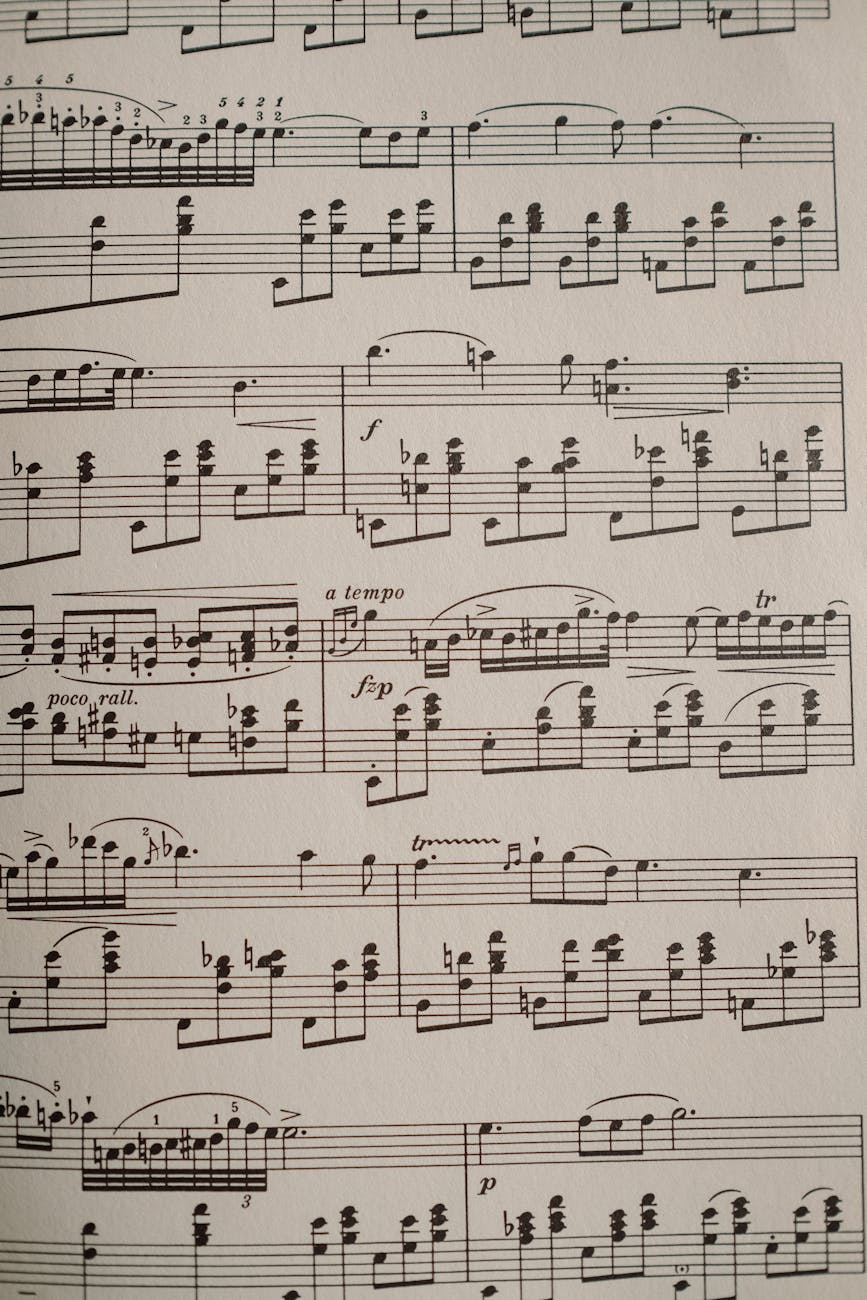
Understanding intervals is essential to reading music, analysing harmony, and building chords. Intervals are the distances between two notes, and you’ll see them everywhere in theory and practical playing.
🔍 What Is an Interval?
An interval is the number of letter names and steps between two notes — for example, C to E is a third, because it spans three note letters: C–D–E.
But intervals also have a quality (major, minor, perfect, etc.) based on the number of semitones.
🎓 Grade-by-Grade Requirements
🎵 Grade 1
- Recognise and write steps and skips (2nds and 3rds)
- Count letter names between two notes (e.g. C–E = a third)
- No need to identify quality yet
📌 Tip: Count from the lower note up, and include both notes when counting.
🎵 Grade 2
- Identify and write intervals:
- 2nds, 3rds, 4ths, 5ths
- Begin distinguishing major and perfect intervals
- Focus on C major key
📌 Tip: Use the C major scale as your measuring stick — any interval that matches it is major or perfect.
🎵 Grade 3
- Intervals up to an octave
- Understand:
- Major, minor, and perfect intervals
- Between tonic and any other note in a key
📌 Tip: A 4th or 5th is “perfect” if it matches the major scale.
If it’s one semitone smaller, it becomes diminished (for perfect intervals) or minor (for major intervals).
🎵 Grade 4
- Recognise:
- Augmented and diminished intervals
- Intervals above and below a given note
- Work in any key
📌 Tip: Start by writing out the scale of the lower note’s key to spot the correct interval quality.
🎵 Grade 5
- Full mastery expected:
- All interval numbers and qualities
- From any note, ascending or descending
- Both harmonic (played together) and melodic (played in sequence)
📌 Tip: Remember enharmonic equivalents (e.g. G♯–B is not the same as G–B)
🧠 How to Work Out Intervals
1. Count the letter names
Example: C–G → C (1), D (2), E (3), F (4), G (5) = a fifth
2. Count semitones
Use a keyboard or piano app to count steps.
3. Know your interval qualities
| Interval | Major | Minor | Perfect | Augmented | Diminished |
|---|---|---|---|---|---|
| 2nd | M2 | m2 | — | A2 | d2 |
| 3rd | M3 | m3 | — | A3 | d3 |
| 4th | — | — | P4 | A4 | d4 |
| 5th | — | — | P5 | A5 | d5 |
| 6th | M6 | m6 | — | A6 | d6 |
| 7th | M7 | m7 | — | A7 | d7 |
| 8th | — | — | P8 | A8 | d8 |
🎯 Practice Tips
🎧 Use Your Ear
Sing or play both notes. Try to hear the distance — 3rds and 5ths are especially recognisable.
🎹 Try it on a Keyboard
See the spacing between notes. Count how many semitones you find.
📝 Write Interval Drills
Choose a starting note and write each interval above it. Then below it. Use both treble and bass clefs.
🕹️ Online Resources
✅ Summary by Grade
| Grade | Required Intervals |
|---|---|
| 1 | 2nds and 3rds (steps and skips) |
| 2 | 2nds to 5ths (number only) |
| 3 | Up to 8ves, major/perfect/minor |
| 4 | Add augmented & diminished, all keys |
| 5 | Full interval ID, ascending & descending, any clef |
 RobboDoesMusic
Leave a comment