
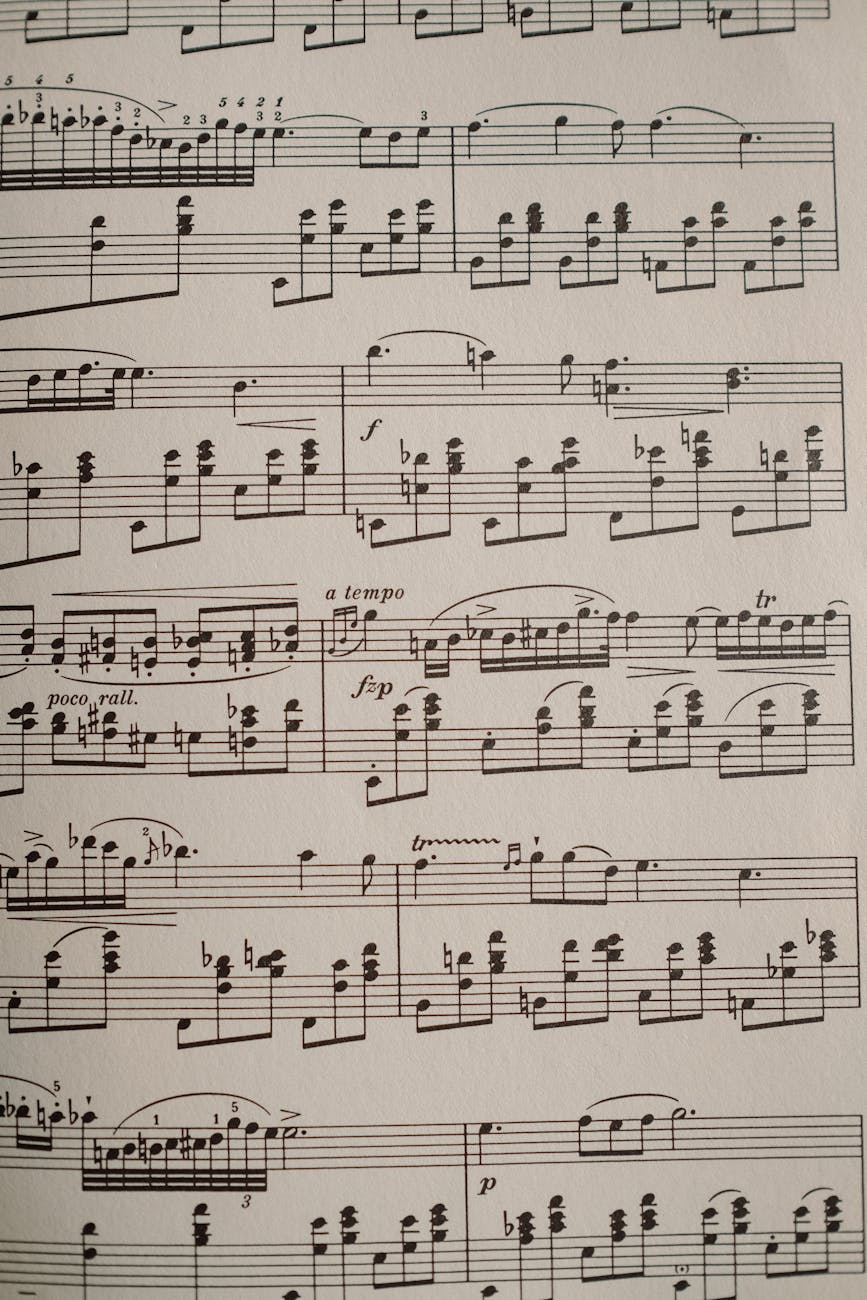
Understanding time signatures and rhythmic values is essential for reading, writing, and performing music accurately. This guide breaks down everything you need to know from Grades 1–5, including beat groupings, simple vs. compound time, and common pitfalls.
🔍 What Is a Time Signature?
A time signature tells you:
- How many beats are in each bar (top number)
- What type of note gets the beat (bottom number)
Example:
3/4 = 3 beats per bar, crotchet (quarter note) is the beat unit (it isn’t always!)
🎓 Grade-by-Grade Requirements
🎵 Grade 1
- Note values: semibreve, minim, crotchet, quaver, semiquaver
- Rests: same as note values
- Time signatures: 2/4, 3/4, 4/4
- Simple rhythm writing and recognition
📌 Tip: Practise writing bars with the correct number of beats.
🎵 Grade 2
- New time signature: 3/2
- More complex rest values
- Basic beaming rules for quavers
📌 Tip: Beams group notes by beat (but there are some caveats… see here for examples)
🎵 Grade 3
- Add time signatures: 2/2 (alla breve) and 6/8
- Introduction to compound time
- Grouping notes/rests correctly in different meters
📌 Key point:
Simple time = beat divides into 2 (e.g. 2/4, 3/4)
Compound time = beat divides into 3 (e.g. 6/8 = 2 dotted crotchet beats)
🎵 Grade 4
- Distinguish between:
- Simple and compound time
- Duple (2 beats), triple (3), quadruple (4)
- More advanced grouping of notes and rests
- Writing rhythms correctly across beats
📌 Tip: In 6/8, quavers are grouped in threes (1 beat = 3 quavers)
🎵 Grade 5
- All time signatures: up to 12/8 and 5/4
- Recognise and convert between:
- Simple ↔ Compound time
- Understand irregular meters (e.g. 5/8, 7/8)
- Apply grouping rules in complex meters
📌 Tip: Learn how dotting affects duration and grouping (e.g. dotted crotchet = 1 beat in 6/8)
🧠 Simple vs Compound Time — Cheat Sheet
| Type | Example | Beats per Bar | Beat Unit |
|---|---|---|---|
| Simple Duple | 2/4 | 2 | Crotchet (1/4 note) |
| Simple Triple | 3/4 | 3 | Crotchet |
| Simple Quadruple | 4/4 | 4 | Crotchet |
| Compound Duple | 6/8 | 2 | Dotted crotchet |
| Compound Triple | 9/8 | 3 | Dotted crotchet |
| Compound Quadruple | 12/8 | 4 | Dotted crotchet |
🛠️ How to Practise
🎧 Clap and count rhythms — Focus on both simple and compound time
📝 Write rhythms — Use manuscript paper to practise grouping
📚 Analyse excerpts — Look at how rests and beams are used in different meters
🧩 Convert between meters — e.g., turn a 3/4 rhythm into 6/8
❗ Common Mistakes to Avoid
- Misgrouping quavers in compound time (e.g., beaming in 6/8 should show 2 beats)
- Using incorrect rest values (e.g., two quaver rests instead of one crotchet rest)
- Ignoring the beat structure in irregular meters (like 5/8: often grouped as 2+3 or 3+2)
✅ Summary by Grade
| Grade | Key Concepts |
|---|---|
| 1 | 2/4, 3/4, 4/4; basic note/rest values |
| 2 | 3/2; more complex rests and simple beaming |
| 3 | Alla breve (2/2), 6/8; intro to compound time |
| 4 | Compare simple vs. compound; accurate grouping in triple/duple/quad meters |
| 5 | Time signatures up to 12/8; irregular meters; complex groupings and conversions |
 RobboDoesMusic
Leave a comment