
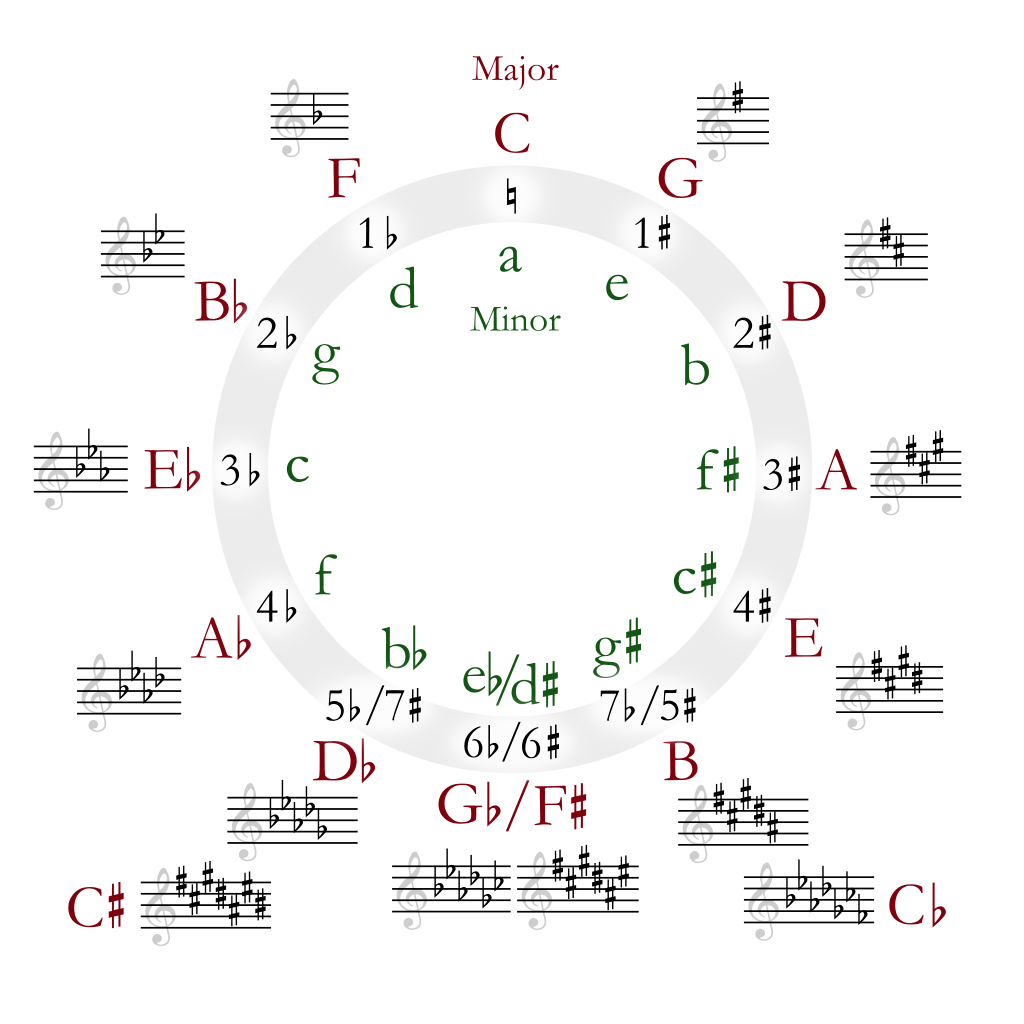
If there’s one diagram that brings together almost everything you need to know about Western music theory, it’s the Circle of Fifths. It’s not just a handy reminder of key signatures—it’s a map that explains how music works on a deeper level, influencing harmony, tonality, chord progressions, cadences, and even the advanced concept of negative harmony.
In this post, we’ll explore what the Circle of Fifths is, why it matters, and how understanding it can unlock so much of the music you love.
🎼 What Is the Circle of Fifths?
The Circle of Fifths arranges all 12 notes of the chromatic scale into a circle, moving by perfect fifths. Starting from C at the top:
- Clockwise = each step adds a sharp
- Anticlockwise = each step adds a flat
It’s based on the natural overtone relationships in music, making it not just a theory but a reflection of the physical world of sound.

- Source: Wikimedia Commons
1️⃣ Harmony & Chord Progressions
One of the most beautiful applications of the Circle of Fifths is in chord progressions. Many satisfying progressions follow anticlockwise movement on the circle.
For example:
- II-V-I in jazz: Dm → G → C
- Pop classics like C → G → Am → Em → F → C → Dm → G—pairs of neighbouring chords on the circle.
2️⃣ Tonality & Modulation
When composers want to change key (modulate), they usually shift to adjacent keys on the circle, because they share many common notes. For example, C major → G major is a very smooth modulation, and you’ll hear it all over classical music, jazz, and pop.
3️⃣ Cadences and Resolution
Perfect cadences (V → I) feel satisfying because they trace this natural harmonic movement anticlockwise around the Circle of Fifths. It’s one of the reasons music feels like it’s “coming home.”
Example: G7 → C
4️⃣ Mastering Key Signatures
- Need to know how many sharps in E major? Count clockwise: C → G → D → A → E = 4 sharps.
- Need 3 flats? Count anticlockwise: C → F → B♭ → E♭.
🗝️ Order of Sharps and Flats in Key Signatures
Even the order of sharps and flats is determined by the Circle of Fifths. Just remember that the first sharp is always F♯ and the first flat is always B♭:
- As you go clockwise, each new sharp is added in a specific order: F♯, C♯, G♯, D♯, A♯, E♯, B♯
- As you go anticlockwise, flats are added in the order: B♭, E♭, A♭, D♭, G♭, C♭, F♭
Learn this, and you’ll never forget a key signature again.The order of sharps and flats around the circle is your lifelong guide.
5️⃣ Negative Harmony: Flipping the Circle
Negative harmony takes things a step further. Contrary to popular belief, it’s not a modern invention. It’s based on ideas from 19th-century harmonic theory, developed more fully by Ernst Levy in his 1985 book A Theory of Harmony. Levy proposed that you could “reflect” chords and progressions across an axis through the centre of the Circle of Fifths, creating mirror-image harmonic movements.
Example:
- C major → reflected → F minor
- G major → reflected → B♭ minor
This idea found new popularity thanks to musicians like Jacob Collier.
🎥 Watch Jacob Collier Explain Negative Harmony:
✅ Bonus Resources
- Wikimedia Circle of Fifths (High Quality): View here
- Circle of Fifths Explained (Dolmetsch Online): Read here
- Jacob Collier on Negative Harmony (YouTube): Watch here
Conclusion: The Musician’s Compass
The Circle of Fifths isn’t just theory—it’s practical, and you’re already using it every time you play chord progressions, recognize key changes, or hear music resolve. Understanding this one concept ties together so many threads of harmony, melody, and form.
 RobboDoesMusic

Leave a comment