
If you’ve ever wondered why certain chords work so well together or how musicians seem to know exactly which chord to play next, the answer usually comes down to one thing: functional harmony.
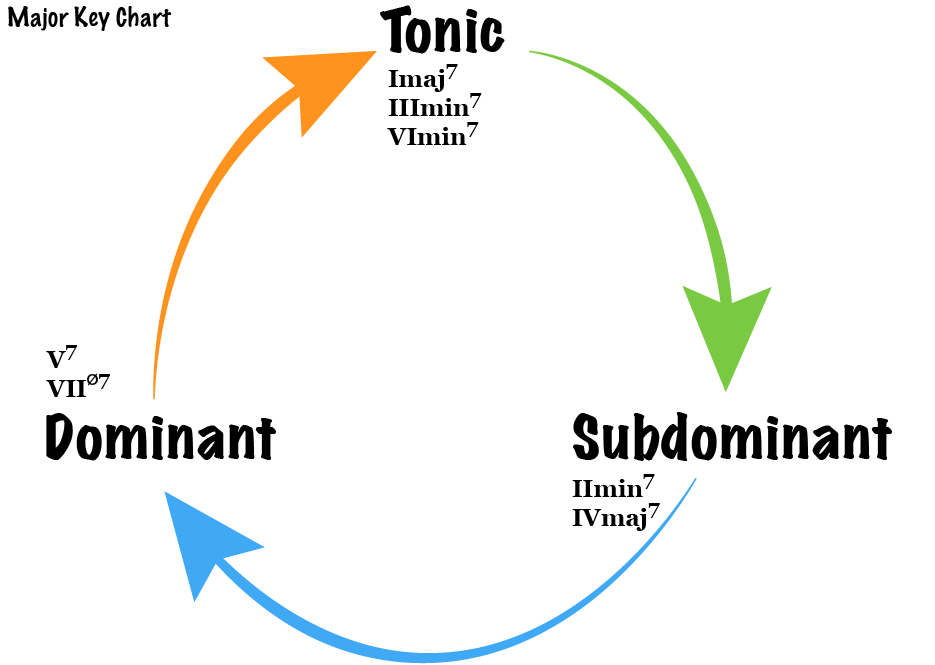
Using the system popularized by the Mapping Tonal Harmony Pro app, we can break down chords into three core “functions”—Tonic, Subdominant, and Dominant. This deceptively simple idea can help you both compose new music and analyze your favourite songs across classical, jazz, pop, and beyond.
Let’s dive in.
🎶 What is Functional Harmony?
Functional harmony is a way of understanding what role a chord plays within a key. Instead of just thinking “this is a C chord,” we start to ask: what does that chord do in the music?
Every chord in tonal music generally serves one of three functions:
| Function | What it does | Typical Examples in C Major |
|---|---|---|
| Tonic | Feels like “home,” restful, resolved | C, Am, sometimes Em |
| Subdominant | Feels like moving away from home | F, Dm |
| Dominant | Creates tension, pulls back to tonic | G, G7, Bdim |
The Mapping Tonal Harmony Pro app visualizes this by mapping chords in a circular or spiral diagram, grouping them by function. It’s a powerful tool for seeing harmonic relationships at a glance.
🗺️ The Map of Harmony
Think of these three functions as regions on a musical map:
- Tonic = Home base 🏠
- Subdominant = Going on a journey 🚶
- Dominant = The road home 🏃♂️
Music often takes a journey like this:
Tonic → Subdominant → Dominant → Tonic
Example (in C major):
C → F → G → C
It’s a cycle that feels natural because of how chords relate to the tonic key center.
🎹 Using Functional Harmony to Compose
When writing music, you don’t have to reinvent the wheel. Knowing how functions work lets you build satisfying progressions by mixing and matching chords within these three zones.
Example 1: Simple Pop Progression
C → F → G → C
(Tonic → Subdominant → Dominant → Tonic)
Example 2: Expanding with Substitutions
C → Dm → G → C
(Dm = Subdominant minor)
Example 3: Jazz Progression
Cmaj7 → Dm7 → G7 → Cmaj7
Even complex jazz chords can still follow the same basic functions!
🔎 Using Functional Harmony to Analyse Music
Functional harmony isn’t just for composers—it’s incredibly helpful for analysing existing pieces.
Example 1: Classical
I → ii → V → I
C → Dm → G → C (e.g., countless symphonies and piano pieces)
Example 2: Jazz (The ‘Turnaround’)
I → vi → ii → V → I
C → Am → Dm → G → C (common in standards)
Example 3: Pop (The Four Chords Song)
I → V → vi → IV
C → G → Am → F
(Anti-clockwise motion on the Circle of Fifths—see how theory links together?)
🌍 Functional Harmony Across Styles
No matter the style:
- Bach → Uses functional harmony in chorales
- The Beatles → “Let It Be” = pure functional harmony
- Stevie Wonder → Funky substitutions but still uses tonic, subdominant, dominant
- Film Music → Dramatic emotional shifts by using deceptive cadences and modal mixture within functional roles
🛠️ Practical Tools: Mapping Tonal Harmony Pro
The Mapping Tonal Harmony Pro app visualizes all this, showing tonal maps that highlight functional zones, progressions, and even alternate pathways between chords.
➡️ Explore the app here: https://mdecks.com/mapharmony.phtml
📝 Summary: Why Functional Harmony Matters
- For Composers: Gives a reliable structure to build emotional, satisfying progressions.
- For Analysts: Provides a universal framework to understand most tonal music.
- For Musicians: Unlocks the connections between pieces, helping you improvise, write, or just enjoy music on a deeper level.

 RobboDoesMusic
Leave a comment