Understanding Functional Harmony: A Composer’s Secret Weapon
If you’ve ever wondered why certain chords work so well together or how musicians seem to know exactly which chord to play next, the answer usually comes down to one thing: functional harmony.
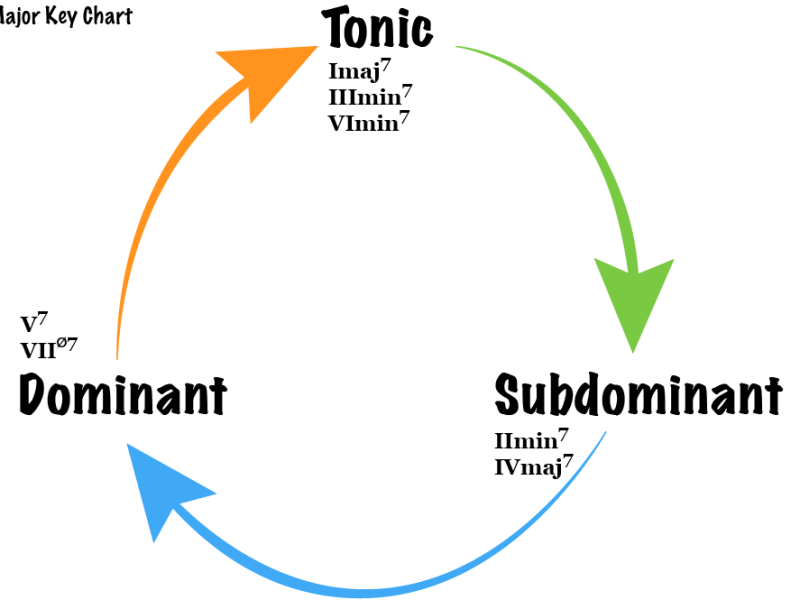
Using the system popularized by the Mapping Tonal Harmony Pro app, we can break down chords into three core “functions”—Tonic, Subdominant, and Dominant. This deceptively simple idea can help you both compose new music and analyze your favourite songs across classical, jazz, pop, and beyond.
Let’s dive in.
🎶 What is Functional Harmony?
Functional harmony is a way of understanding what role a chord plays within a key. Instead of just thinking “this is a C chord,” we start to ask: what does that chord do in the music?
Every chord in tonal music generally serves one of three functions:
| Function | What it does | Typical Examples in C Major |
|---|---|---|
| Tonic | Feels like “home,” restful, resolved | C, Am, sometimes Em |
| Subdominant | Feels like moving away from home | F, Dm |
| Dominant | Creates tension, pulls back to tonic | G, G7, Bdim |
The Mapping Tonal Harmony Pro app visualizes this by mapping chords in a circular or spiral diagram, grouping them by function. It’s a powerful tool for seeing harmonic relationships at a glance.
🗺️ The Map of Harmony
Think of these three functions as regions on a musical map:
- Tonic = Home base 🏠
- Subdominant = Going on a journey 🚶
- Dominant = The road home 🏃♂️
Music often takes a journey like this:
Tonic → Subdominant → Dominant → Tonic
Example (in C major):
C → F → G → C
It’s a cycle that feels natural because of how chords relate to the tonic key center.
🎹 Using Functional Harmony to Compose
When writing music, you don’t have to reinvent the wheel. Knowing how functions work lets you build satisfying progressions by mixing and matching chords within these three zones.
Example 1: Simple Pop Progression
C → F → G → C
(Tonic → Subdominant → Dominant → Tonic)
Example 2: Expanding with Substitutions
C → Dm → G → C
(Dm = Subdominant minor)
Example 3: Jazz Progression
Cmaj7 → Dm7 → G7 → Cmaj7
Even complex jazz chords can still follow the same basic functions!
🔎 Using Functional Harmony to Analyse Music
Functional harmony isn’t just for composers—it’s incredibly helpful for analysing existing pieces.
Example 1: Classical
I → ii → V → I
C → Dm → G → C (e.g., countless symphonies and piano pieces)
Example 2: Jazz (The ‘Turnaround’)
I → vi → ii → V → I
C → Am → Dm → G → C (common in standards)
Example 3: Pop (The Four Chords Song)
I → V → vi → IV
C → G → Am → F
(Anti-clockwise motion on the Circle of Fifths—see how theory links together?)
🌍 Functional Harmony Across Styles
No matter the style:
- Bach → Uses functional harmony in chorales
- The Beatles → “Let It Be” = pure functional harmony
- Stevie Wonder → Funky substitutions but still uses tonic, subdominant, dominant
- Film Music → Dramatic emotional shifts by using deceptive cadences and modal mixture within functional roles
🛠️ Practical Tools: Mapping Tonal Harmony Pro
The Mapping Tonal Harmony Pro app visualizes all this, showing tonal maps that highlight functional zones, progressions, and even alternate pathways between chords.
➡️ Explore the app here: https://mdecks.com/mapharmony.phtml
📝 Summary: Why Functional Harmony Matters
- For Composers: Gives a reliable structure to build emotional, satisfying progressions.
- For Analysts: Provides a universal framework to understand most tonal music.
- For Musicians: Unlocks the connections between pieces, helping you improvise, write, or just enjoy music on a deeper level.

The Circle of Fifths: Your Essential Map for Understanding Music
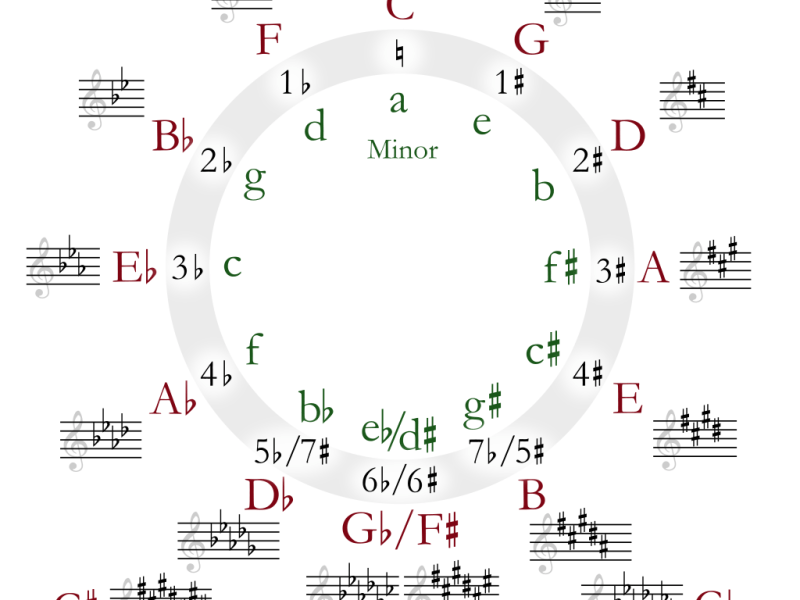
If there’s one diagram that brings together almost everything you need to know about Western music theory, it’s the Circle of Fifths. It’s not just a handy reminder of key signatures—it’s a map that explains how music works on a deeper level, influencing harmony, tonality, chord progressions, cadences, and even the advanced concept of negative harmony.
In this post, we’ll explore what the Circle of Fifths is, why it matters, and how understanding it can unlock so much of the music you love.
🎼 What Is the Circle of Fifths?
The Circle of Fifths arranges all 12 notes of the chromatic scale into a circle, moving by perfect fifths. Starting from C at the top:
- Clockwise = each step adds a sharp
- Anticlockwise = each step adds a flat
It’s based on the natural overtone relationships in music, making it not just a theory but a reflection of the physical world of sound.

- Source: Wikimedia Commons
1️⃣ Harmony & Chord Progressions
One of the most beautiful applications of the Circle of Fifths is in chord progressions. Many satisfying progressions follow anticlockwise movement on the circle.
For example:
- II-V-I in jazz: Dm → G → C
- Pop classics like C → G → Am → Em → F → C → Dm → G—pairs of neighbouring chords on the circle.
2️⃣ Tonality & Modulation
When composers want to change key (modulate), they usually shift to adjacent keys on the circle, because they share many common notes. For example, C major → G major is a very smooth modulation, and you’ll hear it all over classical music, jazz, and pop.
3️⃣ Cadences and Resolution
Perfect cadences (V → I) feel satisfying because they trace this natural harmonic movement anticlockwise around the Circle of Fifths. It’s one of the reasons music feels like it’s “coming home.”
Example: G7 → C
4️⃣ Mastering Key Signatures
- Need to know how many sharps in E major? Count clockwise: C → G → D → A → E = 4 sharps.
- Need 3 flats? Count anticlockwise: C → F → B♭ → E♭.
🗝️ Order of Sharps and Flats in Key Signatures
Even the order of sharps and flats is determined by the Circle of Fifths. Just remember that the first sharp is always F♯ and the first flat is always B♭:
- As you go clockwise, each new sharp is added in a specific order: F♯, C♯, G♯, D♯, A♯, E♯, B♯
- As you go anticlockwise, flats are added in the order: B♭, E♭, A♭, D♭, G♭, C♭, F♭
Learn this, and you’ll never forget a key signature again.The order of sharps and flats around the circle is your lifelong guide.
5️⃣ Negative Harmony: Flipping the Circle
Negative harmony takes things a step further. Contrary to popular belief, it’s not a modern invention. It’s based on ideas from 19th-century harmonic theory, developed more fully by Ernst Levy in his 1985 book A Theory of Harmony. Levy proposed that you could “reflect” chords and progressions across an axis through the centre of the Circle of Fifths, creating mirror-image harmonic movements.
Example:
- C major → reflected → F minor
- G major → reflected → B♭ minor
This idea found new popularity thanks to musicians like Jacob Collier.
🎥 Watch Jacob Collier Explain Negative Harmony:
✅ Bonus Resources
- Wikimedia Circle of Fifths (High Quality): View here
- Circle of Fifths Explained (Dolmetsch Online): Read here
- Jacob Collier on Negative Harmony (YouTube): Watch here
Conclusion: The Musician’s Compass
The Circle of Fifths isn’t just theory—it’s practical, and you’re already using it every time you play chord progressions, recognize key changes, or hear music resolve. Understanding this one concept ties together so many threads of harmony, melody, and form.
🎓 ABRSM Music Theory Grades 1–5: Complete Revision Checklist
🎼 1. Key Signatures & Scales
| Grade | Major Keys | Minor Keys | Scale Knowledge |
|---|---|---|---|
| 1 | C, G, D, F | A, E, D | Tonics, scales, tones/semitones |
| 2 | A, E, B♭ | G, B, E | Key signatures, relative minors |
| 3 | B, A♭ | C♯, C, F | All scales with up to 4 sharps/flats |
| 4 | All major/minor up to 5 sharps/flats | Harmonic minor | |
| 5 | All keys up to 6 sharps/flats | All related minors | Harmonic & melodic minor |
✅ Know relative major/minor pairs
✅ Be able to write and recognise key signatures
🎵 2. Intervals
| Grade | Interval Types Introduced |
|---|---|
| 1 | 2nds, 3rds, 4ths, 5ths, 6ths, 7ths, octaves (number only) |
| 2 | Quality: major & perfect |
| 3 | Minor & augmented intervals |
| 4 | Diminished intervals |
| 5 | Inversions and recognition from both notes |
✅ Recognise by number and quality
✅ Be able to write intervals above or below a note
🎶 3. Chords & Cadences
| Grade | Chords Introduced | Cadences |
|---|---|---|
| 3 | I, IV, V (tonic, subdominant, dominant) | Perfect and imperfect |
| 4 | VI chords | Plagal cadences |
| 5 | Root position & inversions (Ib, V7) | All four cadences incl. interrupted |
✅ Identify chords from key and scale degree
✅ Understand function in harmony
⏱️ 4. Time Signatures & Rhythm
| Grade | Simple Time | Compound Time | Other Concepts |
|---|---|---|---|
| 1 | 2/4, 3/4, 4/4 | — | Note/rest values |
| 2 | 3/2 | — | Beaming rules |
| 3 | 2/2 (alla breve), 6/8 | Intro to compound | Dotted notes |
| 4 | Compare simple/compound | 9/8, 12/8 | Rhythmic grouping |
| 5 | 5/8, 7/8, 5/4 | Full understanding | Time conversion, irregular meter |
✅ Write bars with correct rhythmic grouping
✅ Convert between time signatures
🖋️ 5. Articulation, Dynamics, and Performance Directions
| Grade | Focus |
|---|---|
| 1 | p, f, staccato, legato, common terms (allegro, adagio) |
| 2 | pp, ff, tenuto, fermata, espressivo, a tempo |
| 3 | dolce, marcato, cantabile, expressive markings |
| 4 | Style & character: giocoso, pesante, subito |
| 5 | Advanced terms: rubato, tranquillo, meno mosso, historical context |
✅ Recognise Italian terms in context
✅ Know how expressive markings affect performance
🧱 6. Other Notation & Score Knowledge
| Grade | Concepts Covered |
|---|---|
| 1–5 | Clefs (treble & bass), barlines, ties, slurs, repeat signs, first/second time bars |
| 3–5 | Orchestral instrument families, score reading, transposing instruments |
✅ Understand how to read music fluently
✅ Know orchestral layout (Grade 5)
🧩 7. Aural & Analysis Skills
| Grade | Skills |
|---|---|
| 3–5 | Spotting mistakes in melody/harmony |
| 4–5 | Simple form analysis (binary/ternary), melodic dictation |
| 5 | Identifying cadences, modulations, and keys in context |
✅ Practise by analysing short pieces
✅ Listen and identify musical features
📘 Bonus Revision Tools
- ABRSM Theory Past Papers (Grades 1–5)
- Apps: Tenuto, ABRSM Theory Works
- Online: MusicTheory.net, MyMusicTheory.com
- Flashcards: Create or print key terms and symbols
- Mock exams: Time yourself with past paper-style questions
🕒 ABRSM Music Theory Guide: Time Signatures & Rhythm (Grades 1–5)
Understanding time signatures and rhythmic values is essential for reading, writing, and performing music accurately. This guide breaks down everything you need to know from Grades 1–5, including beat groupings, simple vs. compound time, and common pitfalls.
🔍 What Is a Time Signature?
A time signature tells you:
- How many beats are in each bar (top number)
- What type of note gets the beat (bottom number)
Example:
3/4 = 3 beats per bar, crotchet (quarter note) is the beat unit (it isn’t always!)
🎓 Grade-by-Grade Requirements
🎵 Grade 1
- Note values: semibreve, minim, crotchet, quaver, semiquaver
- Rests: same as note values
- Time signatures: 2/4, 3/4, 4/4
- Simple rhythm writing and recognition
📌 Tip: Practise writing bars with the correct number of beats.
🎵 Grade 2
- New time signature: 3/2
- More complex rest values
- Basic beaming rules for quavers
📌 Tip: Beams group notes by beat (but there are some caveats… see here for examples)
🎵 Grade 3
- Add time signatures: 2/2 (alla breve) and 6/8
- Introduction to compound time
- Grouping notes/rests correctly in different meters
📌 Key point:
Simple time = beat divides into 2 (e.g. 2/4, 3/4)
Compound time = beat divides into 3 (e.g. 6/8 = 2 dotted crotchet beats)
🎵 Grade 4
- Distinguish between:
- Simple and compound time
- Duple (2 beats), triple (3), quadruple (4)
- More advanced grouping of notes and rests
- Writing rhythms correctly across beats
📌 Tip: In 6/8, quavers are grouped in threes (1 beat = 3 quavers)
🎵 Grade 5
- All time signatures: up to 12/8 and 5/4
- Recognise and convert between:
- Simple ↔ Compound time
- Understand irregular meters (e.g. 5/8, 7/8)
- Apply grouping rules in complex meters
📌 Tip: Learn how dotting affects duration and grouping (e.g. dotted crotchet = 1 beat in 6/8)
🧠 Simple vs Compound Time — Cheat Sheet
| Type | Example | Beats per Bar | Beat Unit |
|---|---|---|---|
| Simple Duple | 2/4 | 2 | Crotchet (1/4 note) |
| Simple Triple | 3/4 | 3 | Crotchet |
| Simple Quadruple | 4/4 | 4 | Crotchet |
| Compound Duple | 6/8 | 2 | Dotted crotchet |
| Compound Triple | 9/8 | 3 | Dotted crotchet |
| Compound Quadruple | 12/8 | 4 | Dotted crotchet |
🛠️ How to Practise
🎧 Clap and count rhythms — Focus on both simple and compound time
📝 Write rhythms — Use manuscript paper to practise grouping
📚 Analyse excerpts — Look at how rests and beams are used in different meters
🧩 Convert between meters — e.g., turn a 3/4 rhythm into 6/8
❗ Common Mistakes to Avoid
- Misgrouping quavers in compound time (e.g., beaming in 6/8 should show 2 beats)
- Using incorrect rest values (e.g., two quaver rests instead of one crotchet rest)
- Ignoring the beat structure in irregular meters (like 5/8: often grouped as 2+3 or 3+2)
✅ Summary by Grade
| Grade | Key Concepts |
|---|---|
| 1 | 2/4, 3/4, 4/4; basic note/rest values |
| 2 | 3/2; more complex rests and simple beaming |
| 3 | Alla breve (2/2), 6/8; intro to compound time |
| 4 | Compare simple vs. compound; accurate grouping in triple/duple/quad meters |
| 5 | Time signatures up to 12/8; irregular meters; complex groupings and conversions |
Something went wrong. Please refresh the page and/or try again.
 RobboDoesMusic
